The Business Behind the Brand
GOAT LIFEBreakfast is quick.
Building takes longer.
Ospyr Ventures publishes this independent case study about GOAT LIFE. We examine public information about its products, funding claims, channels and operations. Ospyr Ventures, OSPYR and our founders have no affiliation or business relationship with GOAT LIFE. We did not fund, build, advise or operate it. GOAT LIFE is not our client or portfolio company.
A familiar ingredient. A faster morning. A business that still has to earn the next order.
Original research: 12–13 November archive. Selected source rechecks and direct storefront/new-range capture: 15 November 2026. D2C 002; the GST reflection remains separate Founder Series #1.
A breakfast brand is competing with more than other breakfast brands. It is competing with the alarm someone snoozed, the train they need to catch and the decision to skip eating altogether.
That is the useful place to begin with GOAT LIFE. The product takes a familiar ingredient and changes the work around it: a portioned pouch, a flavour, some liquid and a short preparation routine. Its marketing makes that routine easy to picture. The harder question is whether the business can make the whole experience dependable enough to become an ordinary part of someone's morning.
Shark Tank gives this case a memorable moment. I am more interested in the decisions before and after it: what the pack asks a customer to do, what a sales number actually measures, and what happens when orders arrive faster than expected.
01 product

Start with the morning, not the oats
The current preparation page describes adding liquid, shaking and drinking from the pack or a shaker. The brand advertises a roughly 30-second preparation routine. That is its product claim, not a timing test we conducted.
The positioning makes sense as a business hypothesis. Most people already understand oats. A young brand can still differentiate through format, portion, flavour and the number of steps it removes. The demonstration becomes part of the product's explanation.
Which step does your product remove?
Name the customer's actual occasion, then identify the work the company inherits. Convenience is a hypothesis until customers repeat it.
Founder’s operating question · editorial analysisBut removing work for the customer moves work somewhere else. A pouch has to contain the right blend, hold liquid as intended, carry clear instructions and survive storage and delivery. Convenience is partly an operating decision made before the customer opens the pack.
For another founder, I would ask a small question before a large market-size question: which specific morning becomes easier because this product exists? Then I would test whether people choose it again once the novelty wears off.
02 people

A founder, an earlier experiment and a different format
GOAT LIFE's own history identifies Yash Kalra and dates the brand's beginning to 11 July 2023. Its terms name Kalrascape.We Private Limited as the storefront operator. A brand's launch, the age of its legal entity and its current shareholding are separate facts. Secondary directory YNOS also names Harsh Kalra; that does not give us a complete current founding agreement or equity split. We have not inspected a founding agreement or current cap table.
Indian Retailer's January 2026 account describes Kalra's earlier egg-white beverage venture, Wisegg, and reports shelf-life challenges behind its closure. That is reported founder background; it does not establish why every later GOAT LIFE decision was made.
Still, it is a useful reminder about food businesses. A good idea has to fit the physical product: ingredients, shelf stability, storage, transport, preparation and taste. A founder can change the story quickly. Changing those constraints usually takes more work.
03 nutrition

The protein number belongs to the product version
The current Chocolate Pie page lists a 75g serving and a 15g protein claim. Other flavours in the storefront show 20g, while the general preparation page also uses a broad 20g statement. We therefore do not describe every GOAT LIFE pouch as containing 20g. These are website claims, not our laboratory findings. A current pack and its preparation basis should govern a purchase decision.
A direct storefront check on 15 November 2026 adds another version to that picture: the homepage introduces a 10g range, and the live new-flavours page lists Peanut Butter Chocolate, Filter Coffee and Chocolate Hazelnut in six-, nine- and twelve-pouch variety boxes. The public catalogue lists those new boxes as published on 15 November. That establishes a live listing and a brand-stated range, not a lab result or guaranteed stock at checkout. It supersedes the earlier cached banner that only said a drop was coming.
Who owns the current specification?
Keep the recipe, pack label, website and support answer on the same approved product version. A family-level headline should not replace SKU-specific information.
Founder’s operating question · editorial analysisThis matters beyond nutrition copy. A new flavour can change the formulation, supplier brief, label, pack artwork, product page and customer-support answer. The business needs those versions to agree.
The operating question is simple: who owns the approved specification, and how does everyone know which version is current? An attractive pack is useful. A reliable product record is useful every time another batch is made.
| Range / example | Stated protein | Evidence limit |
|---|---|---|
| Chocolate Pie | 15g; 75g serving | Product-page claim; physical pack not inspected. G05. |
| Other listed high-protein flavours | 20g headlines | SKU-specific copy governs, not a family-level assumption. G01/G04. |
| New Peanut Butter Chocolate / Filter Coffee / Chocolate Hazelnut range | 10g range | Live storefront and new assortment listings captured 15 November. Not a laboratory result or checkout stock guarantee. G12. |
04 basket
A bundle changes the basket, not just the price
On 15 November, the Chocolate Pie page displayed ₹499 for five pouches, ₹949 for ten and ₹1,299 for fifteen. Dividing those displayed bundle prices by pouch count gives ₹99.80, ₹94.90 and ₹86.60 per pouch, before delivery or other checkout differences. Prices and availability can change; no checkout stock audit was performed.
The customer commits more money in return for a lower displayed unit price. The founder's calculation has more rows: acquisition cost, packing, shipping, payment fees, discounts, ingredient cost and the chance that the customer returns.
Is a cheaper unit a better order?
Compare the whole basket after ingredients, shipping, discounts, fees and support. A displayed unit price cannot establish contribution margin.
Founder’s operating question · editorial analysisWe do not know GOAT LIFE's contribution margin on those baskets. A lower price per pouch is not evidence that the larger bundle is more profitable. It gives us a better question to ask about the economics.
The website also offers subscription and build-your-own-box routes. Those are observable purchase options, not a disclosed subscriber count or proof of retention. For a recurring breakfast occasion, renewals and repeat cohorts would be especially useful evidence. They were not available in this review.
05 funding
Keep the funding announcements in separate drawers
Entrackr's 6 January 2026 report describes a ₹1.6 crore extension to an earlier ₹1.1 crore pre-seed round. The named lead was D2C Insider Super Angels, with Consumer Collective by Atrium participating alongside angels including Vikram Ahuja, Akash Gupta and Dhruv Kohli. The investor and founder separately announced the extension. These are financing disclosures, not the company's bank statement or complete share register.
The show agreement is another item. January reporting describes accepted terms of ₹2 crore for 8% from Aman Gupta and Anupam Mittal. Those terms imply ₹25 crore post-money: ₹2 crore divided by 0.08. This is arithmetic on reported television terms, not an independently established current valuation. The official broadcaster confirms the pitch listing; we have not reconciled investment receipts or share allotments.
Which stage did the money reach?
An announcement, negotiated terms, completed diligence, share allotment and cash receipt are separate records. Keep the evidence for each.
Founder’s operating question · editorial analysisIn his own fundraising post, Kalra additionally names Deep Bajaj, Mohit Bajaj, Shiv Dhawan and Gagan Malhotra as existing backers, and Rashi Agarwal, Aditya Agrawal, Akhil Kansal, Aayushi Khandelwal, Venus Dhuria and Karan Kishorepuria among new investors. These are selected publicly named backers, not an independently reconciled current cap table. We do not treat every social tag as proof of an investment.
A fundraising headline, negotiated terms and money received are different stages. Adding every announcement together would make the story look larger without making the evidence stronger.
For someone building a company, I would keep a transaction record with those stages visible. The useful number is the one that answers the decision in front of you.
06 numbers
A monthly sales claim is not an annual account
The January funding coverage reports company-attributed monthly revenue moving from around ₹10 lakh to nearly ₹65 lakh over the preceding months. It also reports approximately 70% of sales through D2C. The investor announcement repeats the monthly sales snapshots.
In the November-drop retrospective, the founder also says the business became profitable that month. That claim belongs in the file, but its accounting basis and durability were not established. We do not turn it into independently verified annual profitability or publish a margin from it.
Would this number survive a change of label?
A monthly sales claim is not an annual account. Write the period, unit, gross/net basis and source next to the number before comparing it.
Founder’s operating question · editorial analysisThese are dated reported claims. The baseline month and gross-to-net accounting bridge are not supplied. They are not audited FY revenue, an annual recurring revenue contract, a current November result or a reliable month-by-month growth series. The accompanying chart keeps the two snapshots separate rather than drawing an invented growth curve.
The approximately 30% non-D2C balance in the sales-mix panel is calculated from the reported 70%; it is not an independently measured channel split.
For a founder, this is where excitement should lead to a more careful spreadsheet. How much cash arrives after discounts and returns? What stock has already been committed? How much must be spent before the next shipment can leave? Public sales pace does not answer those questions by itself.
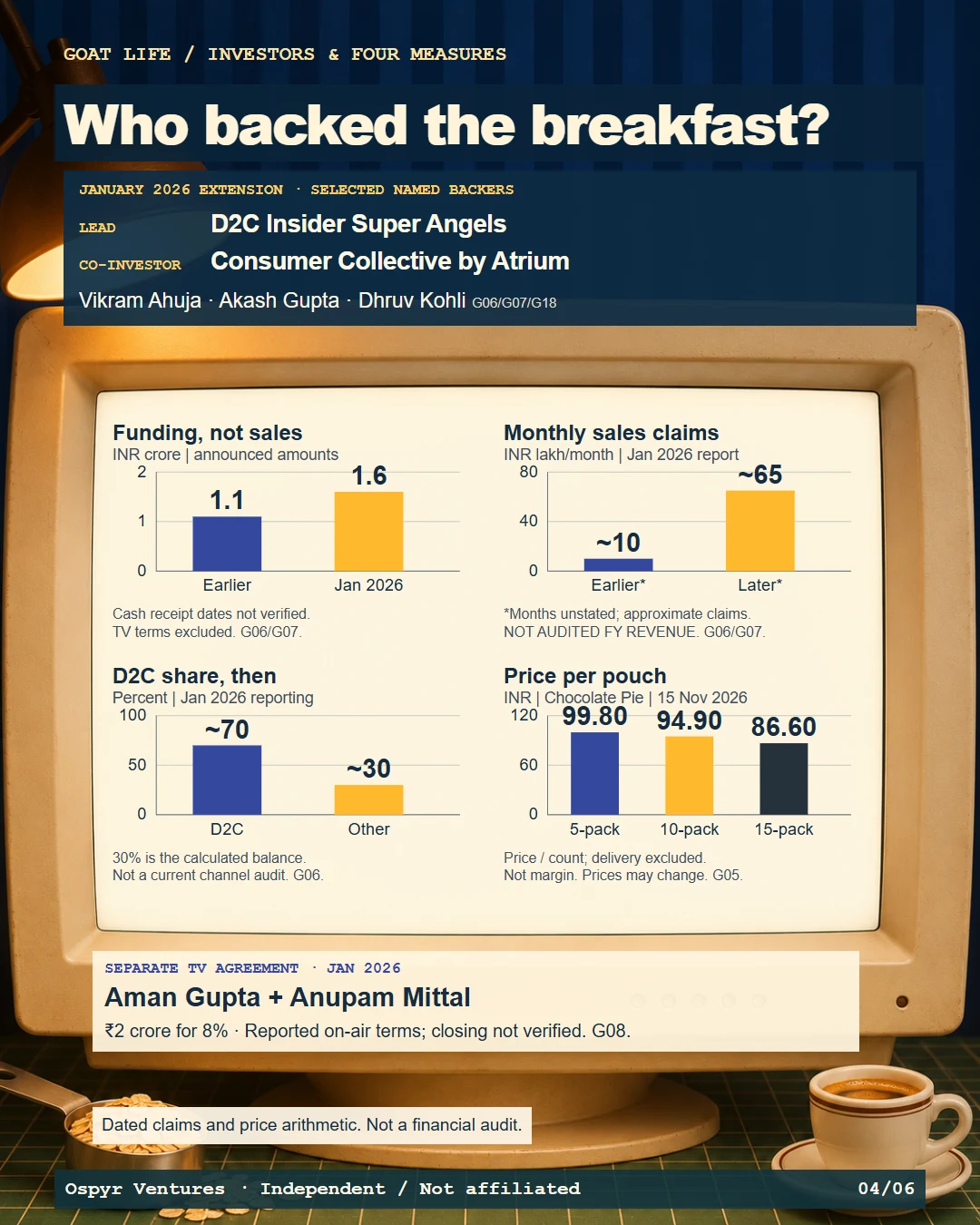
Read the chart values and qualifications
| Measure | Values | Basis |
|---|---|---|
| Financing | ₹1.1cr / ₹1.6cr | Earlier pre-seed and Jan 2026 extension announcements; not cash audit. G06/G07. |
| Monthly sales | ~₹10L / ~₹65L | Approximate company/investor snapshots; months not fully specified. Not audited FY revenue. G06/G07. |
| Sales mix | ~70% / ~30% | Jan 2026 reported D2C share; other is calculated balance. G06. |
| Price / pouch | ₹99.80 / ₹94.90 / ₹86.60 | Displayed ₹499/5, ₹949/10 and ₹1,299/15 on 15 Nov 2026. Delivery excluded; not margin. G05. |
07 distribution

Different channels, different promises
The own-site store gives the brand room for subscriptions, assorted boxes and direct customer communication. The founder’s historical post-show account also names Amazon and Blinkit. January funding statements discuss quick-commerce expansion, including Swiggy Instamart; the historical Zepto statement was a launch expectation. Our 15 November source recheck found a public search-indexed Zepto Brownie Fudge 75g listing, which supports a dated listing observation, not local stock or checkout availability. Platform access should always have a date and a location.
I would keep those routes separate in the operating plan. A direct order, a marketplace shipment and a quick-commerce replenishment can make different demands on the same stock. More routes do not mean more stock exists, and dark-store presence does not establish brand-owned retail shops.
The useful founder decision is what each channel is allowed to promise before the next batch is ready. No channel-by-channel contribution, active-door count or current pin-code stock census was established here.
- Own-site store
- Observed 15 Nov 2026
- Bundles, subscriptions and direct orders. G01.
- Amazon / Blinkit
- Historical founder account
- Named in the post-show retrospective. Current local stock not audited. G09.
- Swiggy Instamart
- January 2026 expansion plan
- Funding coverage describes distribution expansion; not a live pin-code census. G06.
- Zepto
- Public indexed listing observed 15 Nov 2026
- Brownie Fudge 75g listing found during the source recheck; direct page retrieval returned 403. Pin-code stock and checkout not verified. G19.
Channel evidence is dated. These are distribution routes, not brand-owned stores.
08 operations
Attention eventually reaches the dispatch desk
In a public retrospective framed as 20 days after the show aired, Kalra described stock pressure and seven-day dispatch delays for some orders. This is a historical founder self-report, not an independent audit or a statement about current service. The same account discusses Amazon and Blinkit and describes Zepto as an expected forthcoming launch. We do not convert that expectation into verified current availability.
The lesson is the handoff. Marketing creates an order; operations inherit its exact flavour, quantity and delivery promise. A packet that can be prepared quickly still needs ingredients, production, stock allocation, packing and dispatch to line up.
Can every order keep its promise?
Tie available stock, channel commitments and dispatch windows to a named owner. This is an editorial founder checklist, not GOAT LIFE's disclosed internal workflow.
Founder’s operating question · editorial analysisBefore another demand spike, I would want five answers in one place:
Those are an editorial checklist for another founder, not a description of GOAT LIFE's internal software or a claim that a particular tool would have prevented its reported delays.
- Which SKUs can actually be promised today?
- Which units are already reserved for another channel?
- When should the stated dispatch window change?
- Who tells the customer before they have to ask?
- Who owns an exception until it is resolved?
09 manufacturing
Who makes and moves the pack?
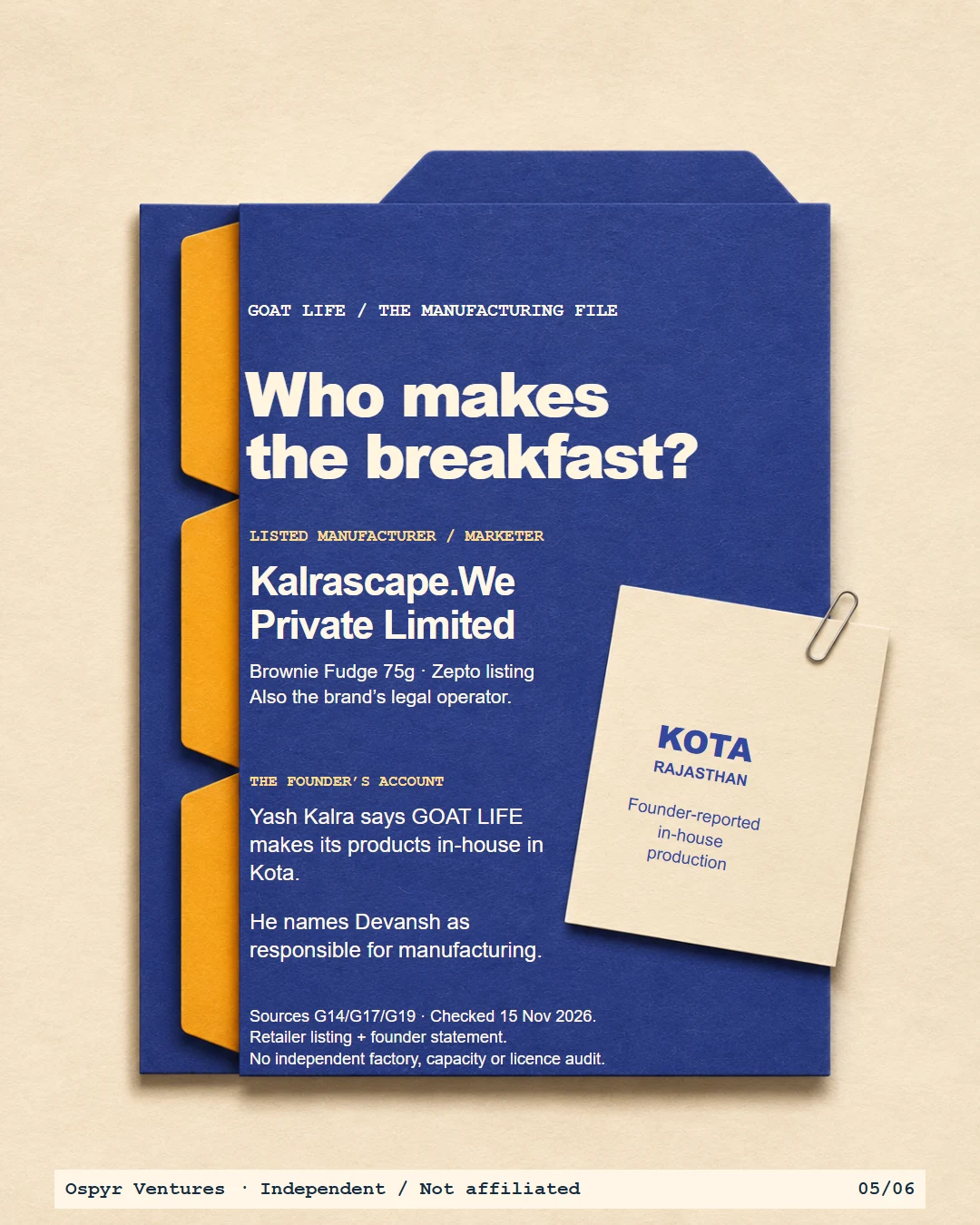
Kalrascape.We Private Limited is the legal company named on GOAT LIFE's own contact page. In a separate public manufacturing post, Yash Kalra says GOAT LIFE makes its products in-house at a facility in Kota and identifies Devansh as responsible for manufacturing. This is a founder statement about the production arrangement; it does not independently establish factory ownership, current capacity or licence status. His historical November-drop account also places manufacturing and dispatch in Kota.
OpenCatalog reproduces retailer-sourced Mocha Marvel manufacturer/marketer details naming Kalrascape.We and FSSAI licence 12223034000313, with a source-read date of 6 September 2026. We did not inspect the original current-batch pack or independently validate that licence in FoSCoS. Treat this as a dated retailer transcription, not a current factory certification.
A public search-indexed Zepto listing for Brownie Fudge 75g also names KALRASCAPE WE PRIVATE LIMITED in its 'Manufacturer or Marketer Name' field. That wording is reproduced as a retailer disclosure, not upgraded into a batch-specific factory audit. The indexed text was checked on 15 November 2026; direct automated retrieval of the retailer page returned 403. Local stock, checkout availability and current-batch label details were not verified.
For another food founder, I would keep the approved recipe, batch release, packaging specification, licence record and dispatch record connected. Those records answer different questions. None should be replaced by a company name on a website.
10 unknowns
What the public file does not establish
We have not established a complete current factory arrangement, production capacity or independently checked current-batch licence record. The legal storefront operator should not automatically be called the owner of a factory. Retailer label transcriptions in the archive are useful leads, not substitutes for original labels and licence checks.
We also do not have reliable disclosed CAC, contribution margins, repeat-purchase cohorts, cash burn, precise current ownership or an audited profitability finding. No defensible current monthly website-traffic series or owned-store count was established. Unknown figures are left unknown, rather than filled with industry averages or zeros.
That does not prevent a useful case study. It changes the conclusion we are entitled to draw. GOAT LIFE provides a way to examine product-format choices and the obligations created by successful discovery. Whether that becomes durable profitable demand requires evidence beyond a pitch and a sales snapshot.
11 Our operating questions

Why this belongs in Ospyr Ventures' learning library
Ospyr Ventures is the parent company through which we are building and documenting our approach to business creation. OSPYR is the business creation and operations platform we are developing. A case like this helps me think about the work between a product idea and a dependable customer experience.
Our intended direction includes manufacturing coordination, packaging, inventory, warehousing, fulfilment and logistics. Longer-term M2C means manufacturer-to-consumer commerce; A2A means agents coordinating with other agents. These are directions we are working towards, not a claim that every capability is live.
The connection is the operating question, not a commercial relationship. Ospyr Ventures, OSPYR and our founders have no affiliation or business relationship with GOAT LIFE. We did not fund, build, advise or operate it.
The part I would take into another business is this: when you remove a step from the customer's morning, write down the work your company must do to keep it removed. That is where a convenient product starts becoming a dependable routine.
12 methodology
Method and corrections
The actual GOAT LIFE dossier in the 12–13 November archive was accessed. Selected public sources were refreshed on 15 November. No private operating dashboards, current physical packs, MCA financial statements, complete cap table, factory audit or full interview transcripts were inspected. Source disclosures are not independent audits of the underlying results. The founder perspective above is editorial analysis, not a direct interview or product trial.
Cached pages initially showed a coming 15 November drop. The direct browser and public-catalogue check subsequently found the live 10g-range page and new assortment listings. Dates on web listings are not laboratory verification or a fulfilled-order test. The public site’s amber and blue accents were inspected directly; original editorial artwork uses those accents with the supplied reference layouts.
The analytics are original editorial charts from the dated figures below. Brand photographs and documentary founder images have not been republished without established rights. Errors and rights concerns can be sent to hello@ospyr.com with the passage, URL and supporting evidence. Full editorial standards: https://ospyrventures.com/editorial-policy.
The cover, food still-lifes and fictional reading characters are original AI-generated editorial illustrations guided by supplied references. No borrowed founder portraits or product photographs are used in these case-study illustrations. Food props are unbranded concepts, not depictions of actual GOAT LIFE products. Text and charts are typeset from checked data. Generic props do not depict GOAT LIFE’s facilities or private operations. Video thumbnails are externally served by YouTube and credited above. Editorial standards and corrections.
The source file
Source dates belong to the underlying publication or snapshot. Primary disclosures verify what was disclosed, not every underlying business result.
- G01 · GOAT LIFE storefrontdynamic; reviewed 15 November 2026.
- G02 · GOAT LIFE termsdynamic; operator disclosure.
- G03 · Brand founder-history account9 January 2026.
- G04 · Preparation pagedynamic; brand claims.
- G05 · Chocolate Pie product pagedynamic; reviewed 15 November 2026.
- G06 · Entrackr funding report6 January 2026.
- G07 · D2C Insider Super Angels announcementJanuary 2026 context.
- G08 · Indian Retailer show report13 January 2026.
- G09 · Yash Kalra's post-show retrospectivehistorical 20-day account.
- G10 · Official SonyLIV pitch listingbroadcaster source.
- G12 · Live new-flavours pagedirectly captured 15 November 2026 alongside the public Shopify product catalogue; live 10g range/assortment listings.
- G13 · Yash Kalra’s November-drop retrospectivehistorical founder claims; accounting basis not verified.
- G14 · Brand contact informationcurrent operator/fulfilment disclosure.
- G15 · OpenCatalog’s Mocha Marvel recordretailer transcription with 6 September 2026 source-read date.
- G16 · YNOS company/founder directorysecondary founding-team crosscheck, not a founding agreement or current share register.
- G17 · Yash Kalra’s in-house manufacturing accountPublic founder statement, rechecked 15 November 2026; names Kota and Devansh. Not an independent facility or licence audit.
- G18 · Yash Kalra’s add-on funding announcementFounder-named investors; January 2026 context; rechecked 15 November 2026. Public names/tags do not constitute a verified cap table.
- G19 · Zepto Brownie Fudge 75g manufacturer/marketer listingPublic search-indexed manufacturer/marketer field checked 15 November 2026. Direct automated page request returned 403; no pin-code stock, checkout, current-batch label or licence audit.