The Business Behind the Brand
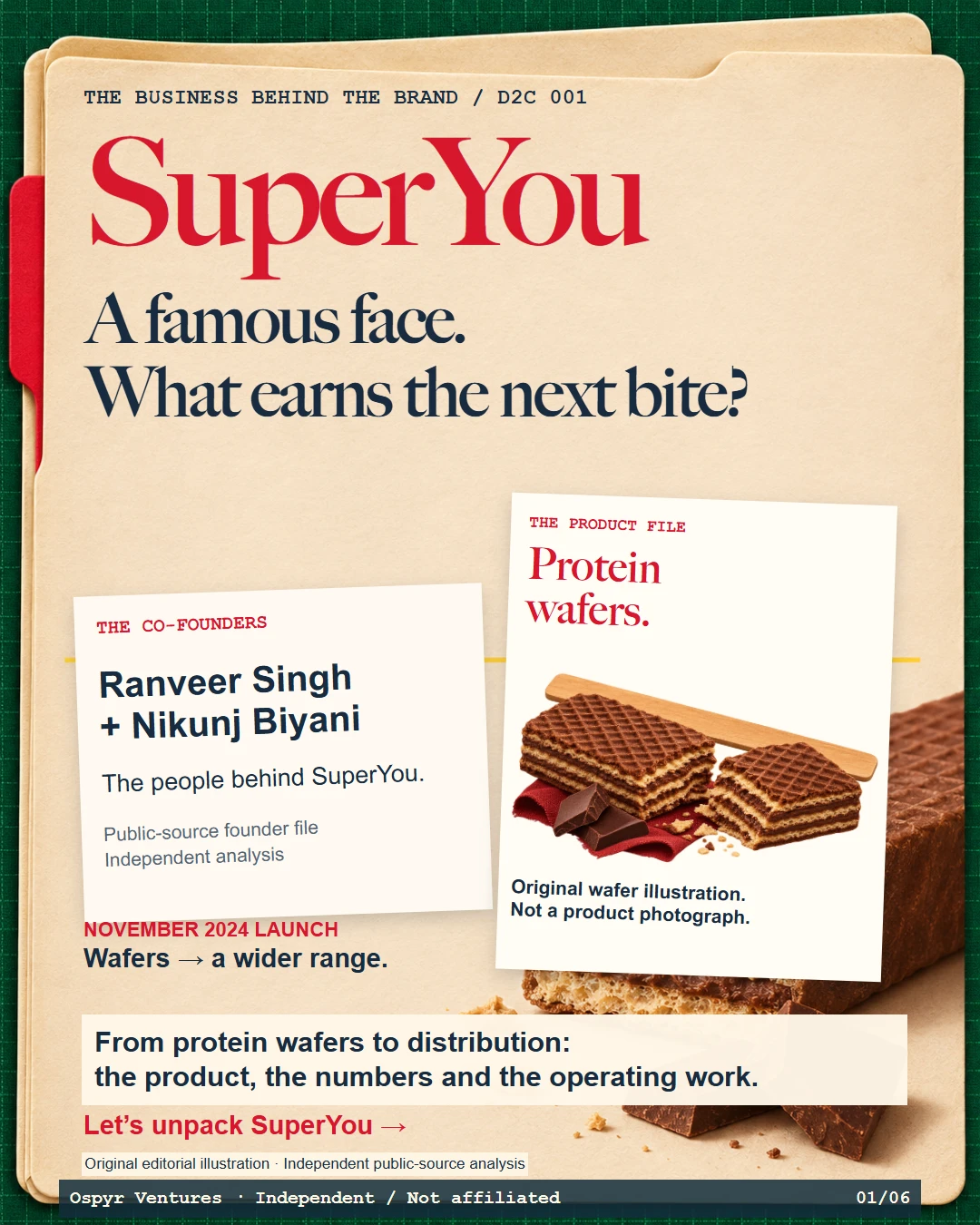
SuperYouAn independent
brand case study.
Ospyr Ventures publishes this independent case study about SuperYou. We examine public information about its products, manufacturers, distribution and finances. Ospyr Ventures, OSPYR and our founders have no affiliation or business relationship with SuperYou. We did not fund, build, advise or operate it. SuperYou is not our client or portfolio company.
I noticed the famous face first. Then I started looking at the company needed to keep the product moving.
Research: 12–13 November archive; selected source rechecks 14 November; Power Puffs and chips update checked . This begins D2C 001. The GST reflection remains separate Founder Series #1.
Ranveer Singh is the easiest part of SuperYou to notice. For someone building a company, the question starts after a customer notices him: can the business deliver something that person wants to buy again?
That is why I wanted to look beyond the launch photograph. There are useful facts here about who is involved, who makes the products, where they sell and what the numbers actually mean. There are also gaps. Keeping both in the picture makes this a more useful case than a celebrity success story.
01 The people

Two founders, a company and a launch date
SuperYou launched in November 2024 with Ranveer Singh and Nikunj Biyani as co-founders. Elite Mindset Private Limited is the company behind it, supported by Think9 Consumer Technologies. The Company Check dates incorporation to 18 March 2024. Company formation and product launch are different milestones; the direct MCA incorporation record was not retrieved for this study.
DMD's June 2025 transaction notice says Nikunj founded Elite Mindset and Singh acquired a 50% stake in November 2024. That establishes a historical equity role beyond an advertising endorsement. It does not establish Singh's current percentage after subsequent financing. The complete current cap table, ESOP pool and dilution are not public evidence we have inspected.
What would I ask beyond the founder photo?
Who owns product decisions, who runs the daily business, and who resolves a disagreement? Public names and historical ownership only begin that conversation.
Founder’s operating question · editorial analysisNikunj brings a consumer-business background, including work in Future Consumer's food business. His Outlook interview describes getting to know Singh through basketball. The founder account hosted by Rainmatter describes Singh's creative and product involvement. Those accounts explain the pairing; they cannot tell us how much sales either founder caused.
That is what interests me about the team. Cultural reach and operating experience can open different doors. Whether customers come back still depends on what happens after those doors open.
02 The product
A familiar snack makes the first decision easier
SuperYou's initial proposition put protein into a familiar wafer format. The standard wafer is advertised with 10g of protein. For a customer who already buys snacks, that asks for a smaller behavioural change than starting a supplement routine. It is a positioning observation, not evidence that every customer needs this product.
The range subsequently moved into multigrain protein chips and fermented-yeast protein powders. The investor-hosted account dates the chips expansion to May 2025. Power Puffs followed as a separate puffed-snack range, with launch coverage published on 3 August 2026. The catalogue also includes 5g minis, 20g mega wafers and creatine. Assortment does not tell us how much revenue each category contributes.
What would make someone choose the next packet?
I would separate launch curiosity from the habit I want to earn. Product format, taste, price and availability are questions to test, rather than proof of repeat purchase.
Founder’s operating question · editorial analysisOn 22 July 2026, SuperYou announced revised wafers using atta and jowar in place of maida, and easier-open packaging. These are the brand's statements about a product version. They do not prove a nutritional advantage, a higher repeat rate or an increase in sales.
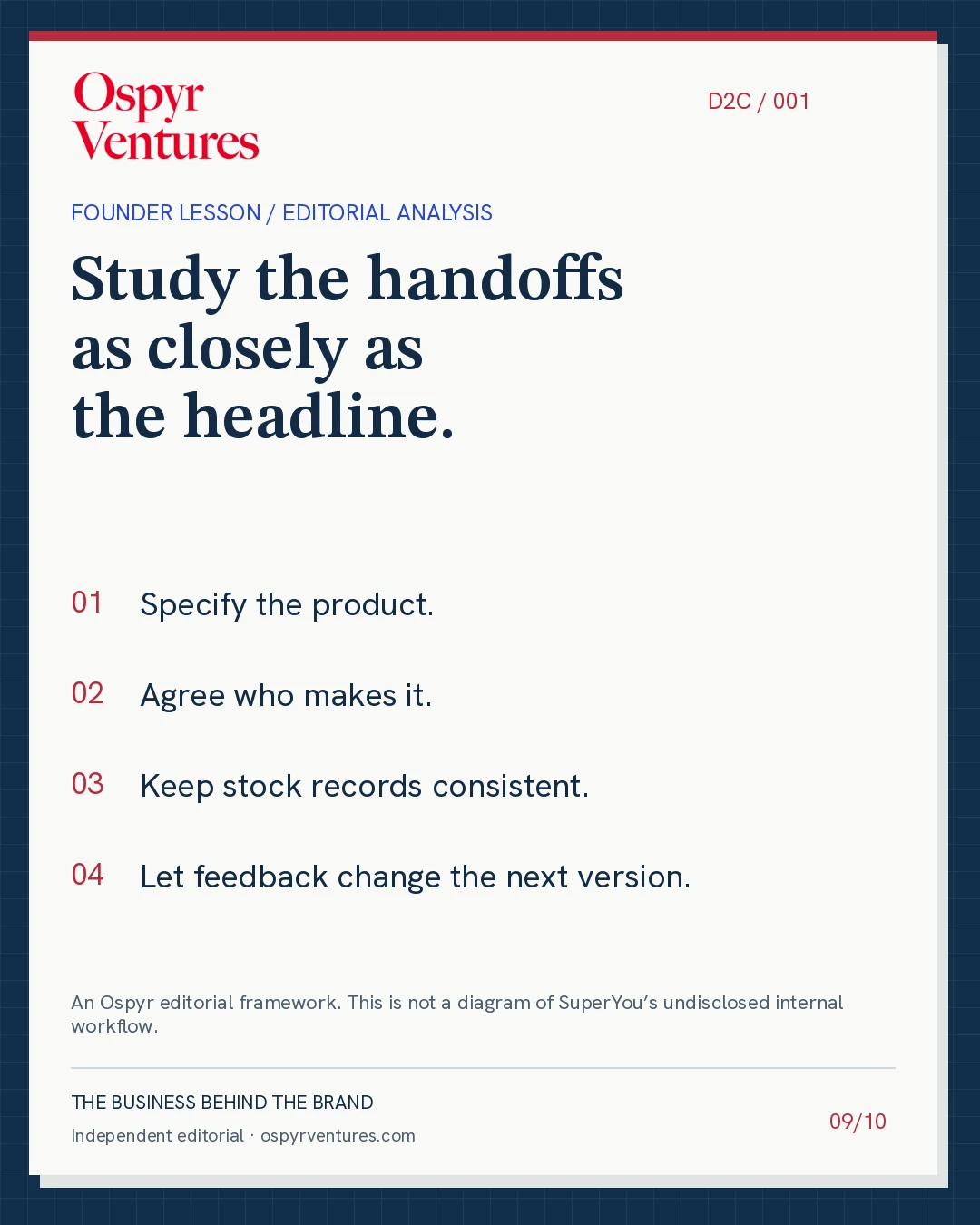
The useful lesson is that feedback has somewhere to go. A comment about taste or a difficult pack can become a product-development decision. Once the product changes, the pack, website, supplier brief and support answer need to describe the same version. That is an operating discipline I would want to build; it is not a claim about SuperYou's private process.
03 Who makes it
Read the manufacturer directory, too
SuperYou publishes named manufacturers by product family. Its directory lists Prayagh Consumer Care Private Limited and Yashheel Foods LLP for wafers; Nutromode Snacks Private Limited and Harry Nutri Bites LLP for chips; and Harry Nutri Bites for puffs. Powder variants name Saipro Industries, H&H Healthcare and Cosmetics, and 3S Fitness Technologies; H&H is also listed for creatine.
The directory includes addresses and FSSAI licence numbers. Those are useful disclosures, although we have not independently verified each licence, historical batch or manufacturing contract. A listed producer is not proof of exclusivity, capacity, factory ownership or who owns a recipe.
Who gets to reject a batch?
I would agree the specification, acceptance standard and responsibility for a failed batch before committing to volume. A manufacturer directory cannot answer those contract questions.
Founder’s operating question · editorial analysisThis is where an apparently simple product range becomes a coordination problem. Someone needs to approve specifications, forecast demand, release batches, reconcile dispatches and deal with rejected or ageing stock. Adding a format can add another set of dependencies. The public directory makes those questions visible without answering them all.
For another founder, I would start with three written answers: who owns the specification, who can reject a batch, and who pays when it misses the agreed standard? A supplier introduction is only the beginning of that relationship.
Evidence
04 Routes to market

Distribution is several businesses happening at once
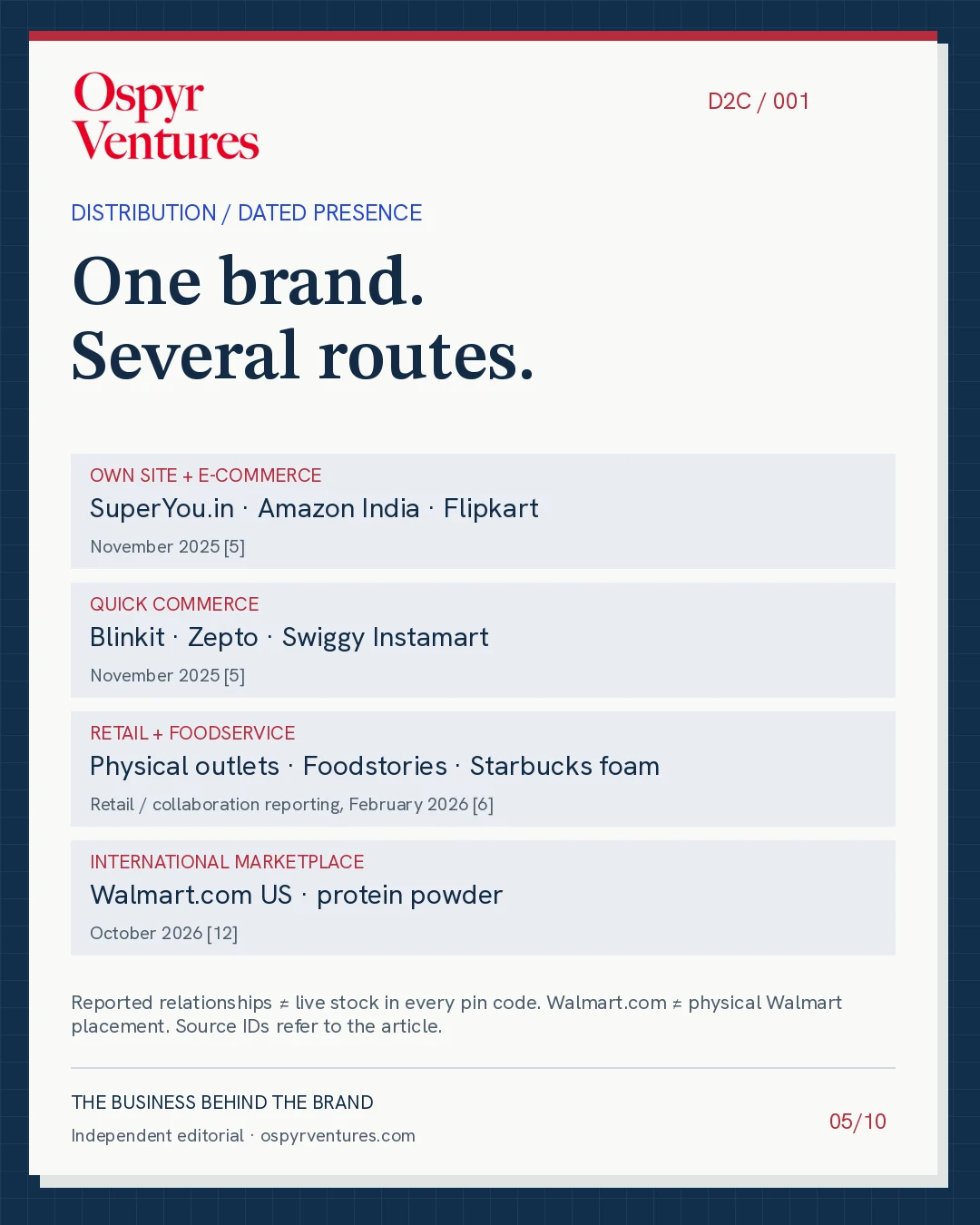
By November 2025, company-attributed reporting named the own website, Amazon India, Flipkart, Blinkit, Zepto and Swiggy Instamart. It also reported more than 4,500 modern- and general-trade outlets. Inc42's December report named offline chains including Reliance Fresh, Wellness Forever and 7/11.
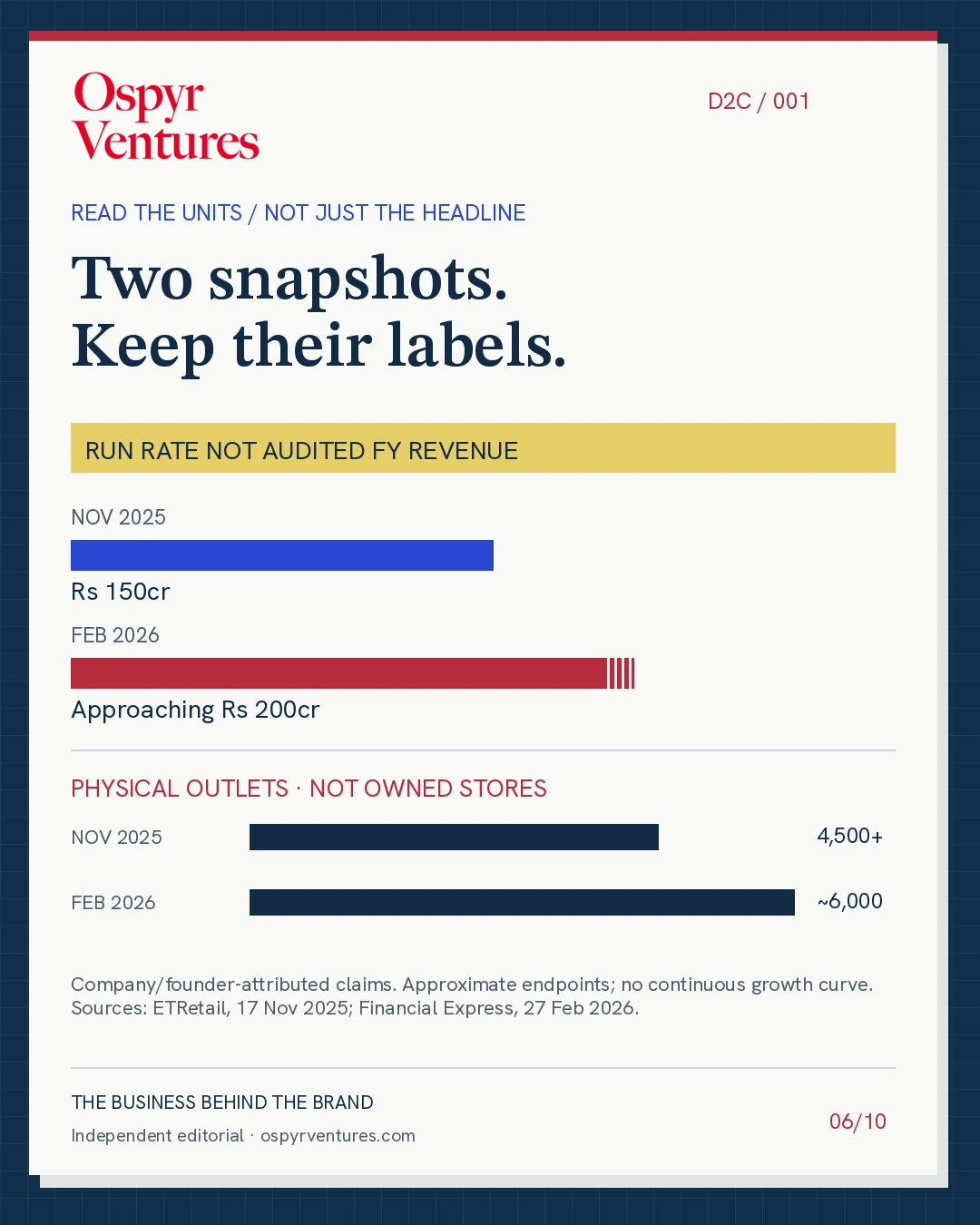
A February 2026 interview put retail distribution at about 6,000 points, and identified Foodstories as another retailer. These are physical outlets selling the brand, not SuperYou-owned stores. The same interview described an ambition to reach 15,000; a target does not belong in a chart of achieved distribution.
What does each new channel ask of the business?
I would write a separate stock, service and cash-cycle plan for a website order, a marketplace sale and a distributor shipment. Distribution counts do not reveal those economics.
Founder’s operating question · editorial analysisAvailability has a date and a location. A reported platform relationship does not establish that every flavour is stocked in every pin code today. Nor does a cumulative outlet count reveal active doors, shelf availability, replenishment frequency or sell-through.
As a founder, I would model each route separately. A website order, a marketplace sale, a quick-commerce replenishment and a distributor shipment create different cash cycles, stock commitments and service obligations. More access can be valuable while still putting pressure on working capital. SuperYou's channel-level economics are not disclosed in the sources reviewed.
Evidence
| Route | Disclosure |
|---|---|
| Own store / e-commerce | Own site, Amazon India, Flipkart · November 2025 [5] |
| Quick commerce | Blinkit, Zepto, Swiggy Instamart · November 2025 [5] |
| Physical retail | 4,500+ outlets, November 2025 [5]; about 6,000 and Foodstories, February 2026 [6]. NOT OWNED STORES. |
| Foodservice | Starbucks India protein cold foam · reported by February 2026 [6] |
| US marketplace | Walmart.com protein powder · October 2026 [12]. Physical Walmart stocking not established. |
05 New occasions
From a packet to a coffee, then a US marketplace
By February 2026, founder-attributed reporting described a Starbucks India collaboration using SuperYou protein cold foam in selected cold beverages. That puts an ingredient proposition into an existing coffee occasion. It is a foodservice relationship, with no disclosed contract economics or independently measured sales uplift in this record.
Mint's 27 October 2026 report describes a US launch of fermented-yeast protein powder, in chocolate and vanilla, on Walmart.com. Its headline mentions wafers and snacks, but the body identifies the launched product as powder. That distinction is worth keeping.
Does the operating model travel with the product?
A new occasion or country changes the questions about compliance, replenishment and customer demand. A channel announcement is the start of that work.
Founder’s operating question · editorial analysisWalmart.com is an online marketplace entry, not evidence of placement across physical Walmart stores. The report described Amazon.com and TikTok Shop as expected next steps. We do not turn those plans into completed launches, or infer US revenue from the listing.
For me, the question is whether the product travels well into a new occasion and operating context. A channel announcement is a starting point for examining compliance, replenishment, local demand and repeat purchase. It does not settle those questions.
06 The stock record
The stock record has to keep up with the marketing
On 5 February 2026, Unicommerce filed an announcement with the stock exchanges about SuperYou's adoption of Uniware. It describes order and inventory management across the brand's website, marketplaces and quick commerce, with warehouse workflow visibility and centralised returns management.
This is primary evidence of an announced technology relationship. The release describes intended operating benefits. It does not disclose a measured reduction in stockouts, fulfilment cost, delivery time or manual work. We should not invent a before-and-after result simply because the integration sounds sensible.
Which record wins when two systems disagree?
I would name an owner for stock allocation, order exceptions and returns, then check whether the software reflects those responsibilities. An integration announcement alone does not measure its result.
Founder’s operating question · editorial analysisEven with that limit, it is a concrete choice worth studying. A customer sees one brand. The business needs stock, orders, warehouse actions and returns to agree across several routes. Attention can create the order; a trustworthy record helps the organisation decide what it can promise next.
The lesson I take is to design that record while a business is still manageable: product and batch identity, available stock, channel allocation, order state, return state and a person responsible for exceptions. Software helps when the underlying responsibilities are clear.
07 Read the units

The numbers need dates and different drawers
SuperYou's November 2025 anniversary coverage reported more than 15 million units sold across wafers and chips, and a ₹150 crore annualised revenue run rate. The February 2026 founder interview described a run rate approaching ₹200 crore. These are company/founder-attributed snapshots of sales pace, not audited full-year revenue.
Some coverage uses the label ARR or annual recurring revenue. In this consumer-goods context, we treat the headline conservatively as a reported annualised run rate. No subscription-like recurrence or consistent annualisation method is established. We have not drawn a continuous growth curve between the two snapshots.
Can these figures honestly share a growth chart?
A short early financial year, a later annualised sales pace and a financing valuation measure different things. I would keep the periods, units and qualifications beside each figure.
Founder’s operating question · editorial analysisFor the earlier FY25 period, The Company Check displayed ₹8.46 crore revenue and a ₹5.69 crore net loss in the 12 November research; StartupPedia separately reported rounded figures of ₹8.5 crore and ₹5.7 crore on 27 February 2026. These are secondary reports. Direct MCA financial statements were not inspected, so the table is not presented as our audit of the accounts.
FY25 ended on 31 March 2025 and included only the first months after the November launch. A later annualised pace describes a different period and measurement. Dividing one by the other to announce a growth percentage would hide that mismatch.
DMD's 23 December 2025 notice corroborates ₹63 crore financing from V3 Ventures, Rainmatter and Gruhas Collective Consumer Fund I. Inc42's 17 December report placed the post-money valuation at ₹600–660 crore, citing a valuation report we have not directly examined. Funding is capital; valuation is a dated financing reference. Neither is revenue, profit or founder earnings.
An October 2025 Mint story had described fundraising discussions at upwards of ₹500 crore valuation. Talks are historical context, not another completed raise to add to a total. We do not claim a current November 2026 valuation from either story.
Evidence
| Period | Figure | What it means |
|---|---|---|
| FY25 | ₹8.46cr revenue; ₹5.69cr net loss | Secondary database figures; direct accounts not inspected. Period ended 31 March 2025. Sources [10, 15]. |
| 17 Nov 2025 | ₹150cr annualised run rate | Company claim in anniversary coverage. Not audited FY revenue. Sources [5]. |
| 27 Feb 2026 | Approaching ₹200cr annualised run rate | Founder-attributed pace. Not audited FY revenue. Sources [6]. |
| Nov 2025 | More than 15 million units | Company-reported cumulative wafers and chips volume; not unique customers. Sources [5]. |
| Dec 2025 | ₹63cr financing | Corroborated by transaction counsel. Capital raised, not sales. Sources [8]. |
| Dec 2025 | ₹600–660cr post-money valuation | Inc42 reporting; underlying valuation report not inspected. Historical, not current. Sources [9]. |
08 The evidence gap

What the public record still cannot tell us
We do not have reliable disclosed cohort retention, channel-level CAC, contribution margins, inventory ageing, expiry losses, working-capital terms or current founder earnings. FY26 audited results and the precise current cap table were not established in this review. An industry average cannot stand in for any of these company numbers.
There is also a product-information limit. The archived chocolate product page had conflicting trans-fat wording between promotional and allergen sections. A physical current-batch label was not examined. We make no laboratory finding or safety judgement from that web-copy inconsistency, and do not assume an old review describes a revised formulation.
What evidence would change my view?
Dated statutory accounts, current product labels and repeated customer and channel measures would answer more than a headline. I would leave the gaps visible until those records are available.
Founder’s operating question · editorial analysisThe sensible next evidence would be actual statutory financial statements, dated batch labels, a reconciled share register and repeated customer and channel measures. Until then, the case supports a study of operating choices. It does not prove durable profitability or that celebrity attention caused repeat demand.
09 The next handoff

What I would take into another company
First, begin with an existing behaviour. The wafer is interesting because it fits a familiar occasion. I would test whether people keep choosing it before treating launch interest as a habit.
Second, write down the handoffs. A new SKU touches specifications, manufacturers, packaging, stock, channels, warehouses and customer support. Ask who owns the decision when the information disagrees.
What would I write down first?
The product brief, who can approve or reject it, the stock record, and who turns feedback into a decision. This is my operating framework, not SuperYou's disclosed internal workflow.
Founder’s operating question · editorial analysisThird, read a number in the unit it was reported. Run rate, realised annual revenue, financing and valuation tell different stories. Keeping them separate makes the actual business easier to understand.
And keep a route from feedback to a product decision. The useful question is what changes for the next customer, and who has the authority to make that happen. These are my operating lessons from the public evidence, not SuperYou's stated internal playbook.
Author's operating analysis.
10 Why I study it
Why I am studying this while building OSPYR
Ospyr Ventures is the parent company through which we are building and documenting our view of business creation. OSPYR is the business creation and operations platform we are working towards. Studying companies like SuperYou helps me ask better questions about the work around a product idea.
Our intended scope includes manufacturing coordination, packaging, inventory, warehousing, fulfilment and logistics, alongside the wider work of starting and operating a business. The longer-term M2C idea means manufacturer-to-consumer commerce; A2A means agents coordinating with other agents. Both depend on reliable product, stock and responsibility records. These are directions we are building towards, not a claim that every capability is available today.
Where does Ospyr Ventures enter this story?
Through what I am learning while building our own company and the OSPYR platform direction. It does not imply an investment, partnership or operating relationship with SuperYou.
Founder’s operating question · editorial analysisOspyr Ventures, OSPYR and our founders have no affiliation or business relationship with SuperYou. We did not fund, build, advise or operate it. This is independent editorial analysis, not an account of work we performed for the brand. The learning informs questions about our own company; it does not connect the two businesses.
I came for the familiar face on the packet. I stayed with the less visible questions: who makes it, where it is stocked, what the numbers mean, and whether the business can keep earning the next purchase. Those are worth understanding long after launch day.
Author's operating analysis.
Research analytics / website estimates
Attention has its own chart. It is not a sales ledger.
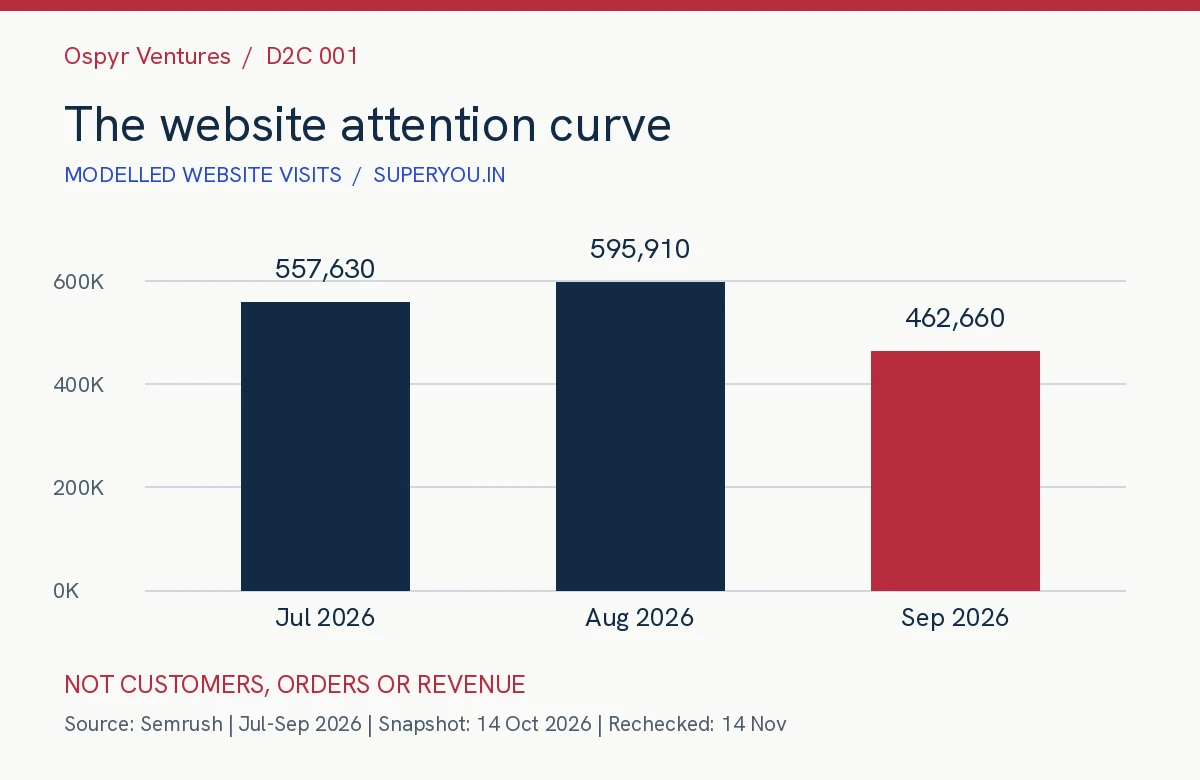
Semrush estimated 557,630 visits in July, 595,910 in August and 462,660 in September 2026 for superyou.in. September was 22.36% below August. These are modelled website visits, not customers, orders or revenue.
View the chart data and limits
| Month | Visits |
|---|---|
| July 2026 | 557,630 |
| August 2026 | 595,910 |
| September 2026 | 462,660 |
Visits can include repeat visits. Marketplace and offline sales sit outside this website measure. This series cannot establish conversion, retention, marketing efficiency or why traffic changed.
How this file was put together
The local 12–13 November D2C research archive, including the complete SuperYou pack and its asset notes, was accessed for this article. Selected primary disclosures and reporting were rechecked on 14 November; the Power Puffs and chips pages and launch coverage were checked on 15 November 2026. The archive contains 20 brand packs; this publication is the first independent brand file, not a claim that all 20 have been re-audited.
We prioritise company and transaction disclosures for identity and relationships, and retain attribution on performance claims. No direct MCA financial statements, current cap table, private analytics, factory audit or current physical product label were inspected. No named independent or specialist reviewer is recorded. The founder perspective is editorial analysis; it does not imply a direct interview with SuperYou.
Charts and vector accents are original editorial graphics. The character illustrations are original AI-generated editorial artwork guided by supplied style references. They are fictional reading and business characters, not SuperYou mascots, portraits of its founders or depictions of its facilities and operations. The cover’s unbranded wafer is an original editorial illustration, not a photograph of a SuperYou product. Founder names appear as sourced editorial text; no founder portraits or copied product photographs are used in this cover. Surrounding materials and props do not depict its private operations. For corrections, see our editorial standards.
The source file
Primary disclosures verify what the organisation disclosed; they do not audit the underlying operating result. Source dates below belong to the original events or publications.
- Rainmatter / Nikunj Biyani, Introducing SuperYou28 May 2025 · Investor-hosted founder account
- DMD Advocates, Rainmatter and Gruhas investment13 June 2025 · Transaction counsel; historical ownership
- SuperYou, chocolate protein waferDynamic product page; reviewed 14 November 2026 · Brand product claims
- SuperYou, manufacturer detailsDynamic directory; reviewed 14 November 2026 · Brand disclosure; licences not independently checked
- ETRetail, first-anniversary report17 November 2025 · Company press-release claims relayed by a publisher
- Financial Express, SuperYou growth interview27 February 2026 · Founder-attributed reporting
- Unicommerce, exchange-filed SuperYou announcement (PDF)5 February 2026 · Listed technology partner's primary disclosure
- DMD Advocates, ₹63 crore financing23 December 2025 · Transaction counsel's corroboration
- Inc42, December financing and valuation17 December 2025 · Filings-based reporting; underlying valuation report not inspected
- The Company Check, Elite Mindset profileDynamic directory; FY25 figures in 12 November research · Secondary database; direct MCA accounts not inspected
- SuperYou, revised-wafer announcement22 July 2026 · Brand account of formulation and packaging changes
- Mint, SuperYou US launch27 October 2026 · Reporting on Walmart.com launch; future channels identified as plans
- Outlook Business, Nikunj Biyani interview3 March 2025 · Founder testimony and background
- Mint, funding discussions23 October 2025 · Reported talks; proposed terms are not a completed deal
- StartupPedia, FY25 results27 February 2026 · Secondary reporting; rounded revenue and loss corroboration
- Semrush, superyou.in traffic overviewJuly–September 2026; vendor snapshot 14 October; rechecked 14 November 2026 · Modelled visits, not first-party analytics
- Semrush, traffic-estimation methodologyReviewed 14 November 2026 · Vendor methodology: clickstream-based estimates
- SuperYou, Power Puffs product pageDynamic page; checked 15 November 2026 · Brand descriptions, flavours and stated channel availability
- SuperYou, Power Puffs FAQsDynamic FAQ; checked 15 November 2026 · Brand claims; protein amounts depend on pack size
- IMPACT, Power Puffs launch coverage3 August 2026 · Launch reporting with company statements; not a performance audit
- SuperYou, Multigrain Protein ChipsDynamic page; checked 15 November 2026 · Brand product and ingredient claims
Clarification · 15 November 2026: Ospyr Ventures, OSPYR and our founders have no affiliation or business relationship with SuperYou. We did not fund, build, advise or operate it. This independent public-source case study is not a client-outcome or portfolio-company claim.
Back to the learning library